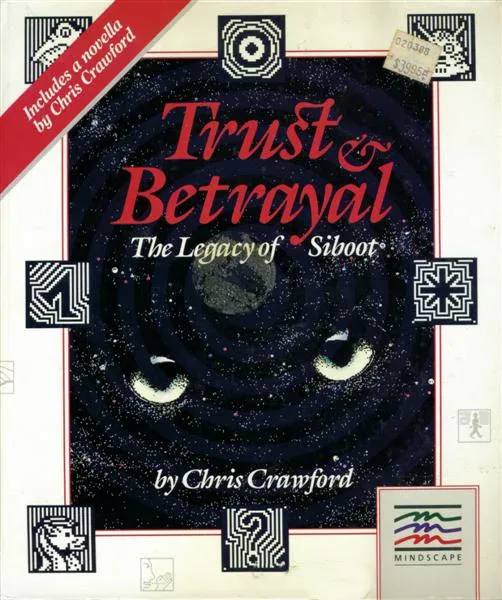
Cover: LaunchBox Games DB
Try playing
ControlsArrows moveEnter selectSpace actionEsc menu / backCtrl fire
The game runs in a DOS emulator: keyboard and mouse work like on an old PC, each game has its own layout (see the hints in the game). There are no on-screen buttons on a phone.
First click the game screen once: after that the keys go to the game, not the page. To scroll the page again, click outside the game window. If the game does not respond, click the game screen again.
The game runs from the Internet Archive site in their emulator; there are no game files on our servers. We show it so you can get to know it; the rights to the game belong to the rights holders. The built-in player has no volume control: if there is no sound or you need to adjust it, open the game page on Internet Archive, which has sound and full-screen buttons. Game page on Internet Archive.
Trust & Betrayal: The Legacy of Siboot
MS-DOS · 1987 · Mindscape
RateSpecs
- Developer
- Chris Crawford
- Publisher
- Mindscape
- First release
- 1987
- Platform
- MS-DOS
- Rarity
- no data
Why
There’s no units produced with a source and not enough listings. We don’t make things up.
Description
Trust and Betrayal: The Legacy of Siboot, also simply known as Siboot, is a unique strategy game by Chris Crawford, designed as a study of the problems of artificial personality and a language of interaction, solving them, as Crawford puts it, "in a pioneering and therefore clumsy fashion". The game plays on Kira, a moon of the planet Lamina.
Read more
The Kira colony was founded as political experiment for cooperation between seven divided alien races. After Lamina was destroyed by a nuclear war, the colony was on its own, and a certain Siboot founded a new civilization, based on a universal telepathic language called "Eeyal" and led by a Shepherd. Now the fourth and last Shepherd has died, and there is a fierce competition between the seven acolytes, including you, for his title. To become Shepherd, you have to collect eight "auras" in three different areas -- tanaga (fear), katsin (trust) and shial (love). At night, the acolytes fight mental duels in a rock-paper-scissors kind, where success depends on knowing the aura ratings of the duelist -- which is why collecting as much information about the others' aura is crucial.. Each morning you awake with the knowledge of one aura rating for each acolyte, and during the day, you try to collect as much information as possible by interacting with your competitors. All this is done an iconic representation of Eeyal, which allows for many ways of interaction like telling, asking, threatening, begging, accusing, promising, yelling, deriding, saying thanks or sorry or just expressing emotion or holding smalltalk. There also is some way of trading information by constructing sentences like "if you tell me the tanaga count of X, I tell you the shial count of Y" -- all this done by clicking small icons. Each competitor has its own personality, and they fear, trust and love each person differently. Everything you do will have effects on the way the acolytes react you, so you will have to find a careful balance between getting enough information and not abusing your allies. The same holds true for the all acolytes, the NPCs are constantly running around and talking to each other to. This and the detailed interaction with them make the NPCs seem very credible and realistic. In between all that interaction, the game is interspersed by "cut scenes" which present you with a certain situation to which you can react in multiple choice style. It offers a save and restore function as well as three difficulty and three game length settings. The game came delivered with a manual and a novella by Chris Crawford which are very helpful to getting started. Trust and Betrayal is surely a highly esoteric and quite experimental game (when exiting, it accurately describes itself as "truly transcendental interactive experience") which is not meant for the casual gamer -- you will first have to get used to the idiosyncratic user interface and the ideas of this game. Still, there are only very few games, if any, that model personal relations and interactions as closely as this game, and it will without doubt be a profound experience for anyone who plays it.
Where to check prices and buy
 eBay
 Amazon
 Kleinanzeigen↗
 Vinted↗
 OLX Poland↗
 Allegro↗
 willhaben↗
 Catawiki↗
 Marktplaats↗
 OLX Ukraine↗
 Rozetka↗
 Prom.ua↗
 Hotline↗
The links open search results for Trust & Betrayal: The Legacy of Siboot MS-DOS in shops and classified sites. We sell nothing and are not responsible for sellers: check the model and code.
Other games
MS-DOS, 1987
More from Mindscape
Reviews and ratings
No reviews yet. Leave the first one: a rating and a few words help others choosing or evaluating the find.
Write a review
Reviews are published instantly. We remove violations upon report.